
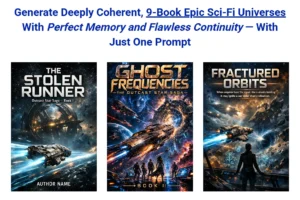
337 Prompts for
Sci-Fi Sagas — Reviewed
Can a 337-prompt AI system really help indie authors build profitable 9-book space opera empires with zero plot holes? We investigated.
The Indie Sci-Fi Gold Rush No One Is Talking About
You’ve probably heard stories of writers striking gold on Amazon’s Kindle Direct Publishing. But few cases are as instructive as Craig’s — a burned-out IT professional who, rejected by every traditional publisher, uploaded his sci-fi manuscript directly to Amazon and built a multi-million-dollar publishing empire that eventually hit the New York Times Bestseller list.
The most staggering data point? By Book 19 in his saga, Craig was seeing an estimated 69 organic eBook sales per day — without running ads. That’s the compounding power of a deeply interconnected multi-book universe at work.
That insight — the “Mega-Saga” business model — is the intellectual backbone of this product. And the core problem it solves is very real: maintaining continuity across 9+ books is notoriously difficult, even for experienced authors. AI tools like standard ChatGPT famously forget what happened in Chapter 1 by the time they reach Chapter 5. 337 Prompts for Sci-Fi Sagas claims to have cracked that problem.
This review breaks down exactly how — and whether it delivers.
Get 337 Prompts for Sci-Fi Sagas →
>>> Get EarlyBird Discount & 300+ Bonus Bundle (worth $43K) <<<
What Exactly Is 337 Prompts for Sci-Fi Sagas?
At its core, this is a premium prompt engineering kit designed to transform standard ChatGPT into what the creators call a “Franchise Engine” — a disciplined, continuity-locked AI system capable of generating 9-book epic sci-fi universes with consistent characters, physics, politics, and lore.
It’s built for indie authors targeting the Amazon KDP and Kindle Unlimited ecosystems, specifically the voracious Science Fiction and Space Opera readership. Here’s exactly what’s included:
Saga-Builder Prompts
337 prompts across 48 high-demand sci-fi trope categories. Each generates a complete “Galactic Archive” — the canonical brain of your franchise with characters, physics rules, faction politics, and a 9-book macro outline.
Canon Lock Technology
The system’s secret weapon. After completing each book, a special “Canon Lock Prompt” generates a Galactic Update file — permanently recording injuries, depleted resources, political shifts, and new revelations for perfect continuity.
The Book Prompt
Generates a professional 13-page chapter-by-chapter outline, Amazon KDP description, SEO keywords, and a photorealistic AI cover image prompt — for any specific book in your saga.
The Page Prompt
Forces the AI to write lush 1,500–2,000 word scenes with sensory grounding, sharp dialogue, visible technological costs (hull damage, reactor drain), and cliffhangers — all within your universe’s strict canon.
Anti-Hallucination Guardrails
Explicitly bans the AI from retconning, inventing plot holes, or using “magical fixes.” FTL travel has limits, weapons overheat, reactors drain — grounded realism is enforced by design.
Zero-Guesswork Master Guide
A screenshot-by-screenshot walkthrough for absolute beginners — covering how to set up Custom GPTs, create Knowledge Files, and deploy your first Galactic Archive from scratch.
Reverse-Engineered From Bestselling Amazon Sci-Fi
The 337 prompts aren’t random — they’re organized around the highest-demand tropes in the space opera genre, specifically chosen because they drive binge-reading behavior on Amazon KDP. A sampling of what’s covered:
Plus 30 additional categories including corporate heists, floating prison planets, diplomatic escort missions, and alien-human sarcasm misunderstandings.
The 3-Step System: Build → Write → Scale
Despite the technical sophistication hidden inside the prompts, the actual user experience is designed to be remarkably simple — copy, paste, and follow the map.
Initialize Your Saga Engine
Select one of the 337 Saga-Builder Prompts (e.g., “Cyberpunk Dystopia” or “Awakening Cosmic Entity”), paste it into ChatGPT, and in seconds the AI generates your Galactic Archive — a complete Custom GPT Knowledge Base defining your universe’s physics, factions, crew dynamics, and a full 9-book structural roadmap. You now have a specialized AI assistant that knows your universe before you write a single word.
Generate Content & Professional Packaging
Use the Book Prompt to generate a 13-page cinematic chapter outline, Amazon-ready title and description, SEO keywords, and an AI cover art generation prompt. Then use the Page Prompt to produce 1,500–2,000 word scenes that enforce sensory detail, technological costs, and lore continuity. The result is a publish-ready book package — text and visuals — in a fraction of the normal time.
Lock Canon & Scale Your Backlist
After finishing each book, run the Canon Lock Prompt to generate a Galactic Update file capturing every new consequence — destroyed ships, character injuries, political shifts, revealed secrets. Upload this back to your Custom GPT, and it now carries flawless memory into Book 2, Book 3, and all the way to Book 9. Repeat the process and build a massive, highly profitable backlist.
Does the AI Actually Write Good Prose?
The question every skeptic asks — and rightly so. We examined the sample outputs included in the product’s own documentation. Here’s a genuine excerpt from the Page Prompt output (Book I, Page 1):
That passage is genuinely impressive. The sensory grounding (“metallic enough to taste”), the character-revealing behavioral detail (“the way Imperial officers were trained to walk”), and the economic pacing are all hallmarks of competent genre fiction — not the hollow filler typical of unguided AI output.
The key differentiator appears to be the prompt’s explicit mandates: sensory grounding required, technological costs required, character voice enforcement required. The AI isn’t given freedom to be generic. It’s constrained to be specific, and specificity is what makes fiction feel real.
The sample Book I outline also demonstrates impressive structural intelligence — a 13-page scene-by-scene blueprint that correctly balances action (20%), exploration/tactical (50%), and character-driven moments (30%), with an escalating antagonist reveal and genuine cliffhanger architecture at the midpoint and finale.
The 6-Layer Amazon KDP Strategy
The product isn’t just prompts — it includes a concrete publishing and monetization framework built around how the Amazon algorithm and Kindle Unlimited royalty system actually work. The strategy is sophisticated and grounded in real indie publishing principles:
Weekly Release Cadence
AI-assisted drafting makes weekly 15,000–20,000 word releases feasible, keeping you perpetually visible in Amazon’s “New Releases” algorithm — the single biggest organic traffic driver for indie authors.
Pilot Episode Testing
Launch Book 1 for three different sagas simultaneously, identify which trope pulls the most page reads and purchases, then double down on the winner. Data-driven before commitment.
Kindle Unlimited Flywheel
Enroll in KDP Select. Sci-Fi readers are the heaviest KU users. Free access removes purchase friction, builds readership fast, and generates escalating page-read royalties as readers binge the series.
Impulse-Buy Pricing
Price individual novellas at $2.99–$3.99 to capture the 70% royalty tier while staying below the “think twice” threshold. Impulse buys at low prices compound powerfully across a 9-book series.
Saga Bundle Ladder
Release 3-book box sets at $6.99, a complete omnibus at $14.99–$19.99. Same content, multiple price points — capturing both episodic readers and binge buyers simultaneously.
Trophy Paperback Upsell
Create physical editions for box sets and the complete saga. Superfans collect. Price at $24.99–$34.99 to capture high-ticket buyers who already read the digital edition.
Who Is This Actually Built For?
People with day jobs who want to build a passive digital publishing income stream without quitting to write full-time.
Writers who have ideas but struggle with plotting, pacing, world-building consistency, or the sheer time commitment of a multi-book series.
Self-publishers already on Amazon who want to enter the lucrative Sci-Fi/Space Opera niche with a proven structural framework instead of guessing.
People already using ChatGPT for content who want to go beyond generic output and produce commercially viable, publication-ready fiction at scale.
Category Scores: How It Performs
| Prompt Quality & Depth | |
| Continuity System (Canon Lock) | |
| Output Prose Quality | |
| Amazon KDP Strategy Soundness | |
| Trope Variety & Market Fit | |
| Ease of Use for Beginners | |
| Value for Price |
The Good, The Limitations
✦ Strengths
- Canon Lock system genuinely solves the AI continuity problem — the most critical flaw in AI-assisted long fiction
- Anti-hallucination guardrails force grounded, high-stakes storytelling rather than generic space adventures
- 337 prompts across 48 tropes provides exceptional variety — no two sagas will feel alike
- Included KDP strategy is sophisticated, actionable, and rooted in how Amazon’s algorithm actually rewards indie authors
- Sample outputs demonstrate genuinely competitive prose quality with real sensory depth and character voice
- Beginner-friendly step-by-step guide removes the technical barrier of Custom GPT setup
- Book packaging (outline + description + SEO keywords + cover prompt) is a complete professional asset, not just a draft
- Sci-Fi market targeting is smart — it’s one of the most binge-driven genres on Kindle Unlimited
✦ Limitations
- Requires an active ChatGPT subscription with Custom GPT access — not a one-time tool
- Human editorial review and revision still necessary — AI output is a strong first draft, not a finished manuscript
- Success on Amazon still requires marketing effort; prompts generate the content, not the readership
- Exclusively sci-fi/space opera focused — not useful for authors in other genres
- AI cover prompts are strong starting points, but final cover quality depends on your chosen image generation tool
Final Verdict: Is It Worth It?
The single biggest obstacle to building a profitable multi-book sci-fi series has always been continuity management — keeping track of an expanding universe across thousands of pages without plot holes destroying reader trust. Standard AI tools fail catastrophically at this task.
337 Prompts for Sci-Fi Sagas tackles that problem with genuine engineering sophistication: the Galactic Archive system, the Canon Lock prompt, and the explicit anti-hallucination guardrails represent a meaningfully different approach to AI-assisted long fiction — not just another list of story starters.
The included KDP business framework is equally serious. The Pilot Episode testing method, weekly release cadence strategy, and Saga Bundle pricing ladder are tactics that reflect a real understanding of how the Amazon algorithm rewards indie sci-fi publishers.
For aspiring indie authors targeting the sci-fi/space opera niche on Amazon, this product offers remarkable leverage at a price point that makes it an easy decision. The framework does the structural heavy lifting; your job is to bring human judgment, editorial polish, and marketing effort to the table.
Highly Recommended for Indie Sci-Fi Publishers
A genuinely sophisticated AI prompt system that solves real problems — continuity, pacing, and professional packaging — that have kept indie sci-fi authors stuck at Book 1. Combined with a smart Amazon KDP strategy framework, this is one of the most actionable publishing tools in the AI space. Requires human editorial input and marketing effort, but the structural foundation it provides is exceptional.
Start Building Your
Galactic Empire
Join indie authors using the 337-prompt Franchise Engine to build 9-book sci-fi sagas with perfect AI-powered continuity — and publish on Amazon KDP with professional-grade packaging from day one.
Get 337 Prompts for Sci-Fi Sagas →REMEMBER! If you buy this product through my link, you can also get these huge bonuses (Please remember that these bonuses are not for the TRIAL or FREE versions):
You can have an opportunity to receive extra bonuses if you finish 2 steps below:
♦ Step 1: Order the product by Clicking Here.
♦ Step 2: After your purchase goes through, you will get all the bonuses through email.